Vibe Coding vs. Dev Agency: What Startups Should Choose
Published November 2, 2026Updated November 6, 2026
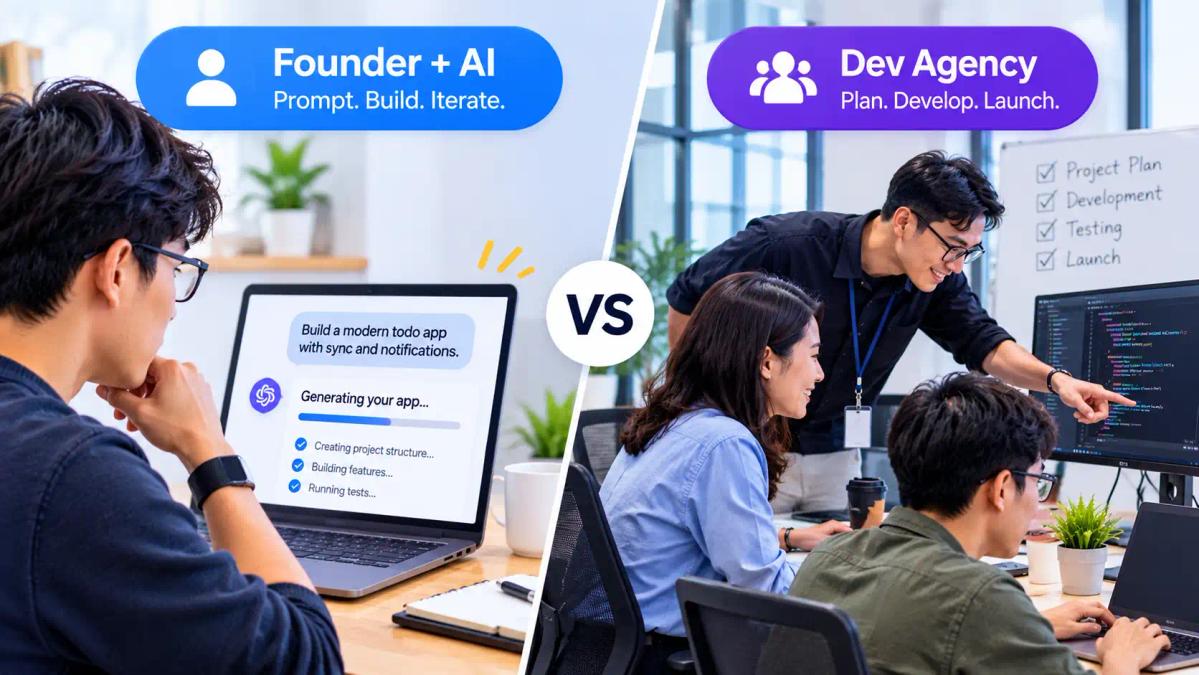
Have an idea worth shipping?
Book a free 30-minute call — no sales pitch, just a clear plan and a fixed-price quote for your product.
Book a free 30-minute call — no sales pitch, just a clear plan and a fixed-price quote for your product.
TL;DR: Vibe coding means building software by describing what you want to AI tools like Cursor, Lovable, or Claude. It's fast, cheap, and great for validating ideas. Hiring a dev agency costs more upfront but buys you production-grade quality and long-term maintainability, with security built into the process. Testing an idea or building an internal tool? Vibe code it. Building something that handles customer data or payments, or that needs to scale? Bring in professionals, or at least have one review your work.
Vibe coding is building software by describing features in plain language and letting AI coding assistants write most of the code. You prompt, the AI generates, you review (or sometimes don't), you iterate. Andrej Karpathy coined the term in early 2025 when he described "fully giving in to the vibes" and barely looking at the code the AI produced.
That "barely looking" part is the personality of the whole method. Traditional development treats the code as the product. Vibe coding treats the working demo as the product and the code as a disposable byproduct. That mindset is exactly why it's fast, and exactly where it gets dangerous.
It's for non-technical founders, indie hackers, product managers, and yes, even experienced developers who want to move faster. If you've never written a line of code, tools like Lovable, Bolt, and Replit let you ship a working prototype in an afternoon. If you already write code, tools like Cursor and Windsurf sit inside your editor and take the boilerplate off your hands while you keep making the architectural calls.
The common thread isn't skill level. It's stakes. Vibe coding fits people whose biggest risk is spending three months and $40,000 building something nobody wants, and whose smallest risk is a prototype that breaks.
The sweet spots:
The wrong times:
All you need is a browser or a code editor. Cursor and Windsurf run on your machine and suit people comfortable with a repository. Lovable, Bolt, and v0 run in the cloud and suit people who think in screens, not files. No dev environment setup, no hiring process, no agency contracts.
Speed and cost. A project that would take an agency 6–8 weeks and $30,000–$80,000 can often be prototyped in days for the price of a few AI subscriptions ($20–$200/month). That's not hype. It has genuinely changed how early products get built, because the cost of discovering your idea is bad dropped from a five-figure invoice to a weekend.
The flip side of that cheapness: everyone else's experiment is cheap too. Fast validation is only an advantage if you act on what you learn.
You describe what you want ("Build me a booking app where customers pick a time slot and get a confirmation email"), the AI generates the code, you test it, then you refine with follow-up prompts. A real session is a long conversation. You click around, find what's broken, paste the error back in, and hope the fix doesn't break two other things.
The catch: your output quality depends heavily on how clearly you can describe the problem. Vague prompt, vague app. And someone still needs to catch the bugs, security holes, and architectural messes AI happily creates, because the AI optimizes for code that runs, not code that lasts.
Vibe coding got the full 5W+1H treatment above, so the agency side deserves the same depth. Start with the uncomfortable part: you're not really buying code.
Code is the visible deliverable, but it's the least valuable thing on the invoice. The real product of a good agency engagement is judgment. Which features to cut from v1. Which stack won't strand you in eighteen months. Which shortcut is safe to take and which one becomes next year's rewrite. You're also buying process (code review, testing, staging environments, security habits) and accountability (a contract that says someone else fixes it when it breaks). A freelancer can sell you judgment and process. A proper team gives you accountability too, because the work doesn't live in one person's laptop.
Three models, three personalities:
For a first MVP, fixed price with a written scope is usually the right call. It forces the agency to think the project through before quoting. It forces you to as well.
Complexity, integrations, regulated data, team seniority, and how fast you need it. A simple app with a login sits at the bottom of the range. Payments, several third-party integrations (each one is a negotiation with someone else's API), or health and financial compliance push you toward the top. That's how "an MVP" spans $20,000 to $150,000+.
What you bring matters just as much. A founder who arrives with validated demand, user feedback, and a rough spec gets a faster, cheaper build than one who says "I want an app like Uber." This is the strongest case for vibe coding the prototype first. It converts you into the client with answers, which is the client every good agency prices kindly.
The shape is fairly standard across decent shops. Discovery call. Written scope with milestones. Iterative builds where something you can click lands on a staging link every week or two. Launch. Then support or a clean handover. The specifics worth demanding: weekly demos on a live link rather than screenshots, a fixed quote agreed before any work starts, your name on the repo and the IP from day one, and documentation a stranger could read.
The handover clause matters more than it sounds. If you part ways with the agency in a year, good docs and a clean repository are what stop your next developer from billing you two months just to understand the codebase.
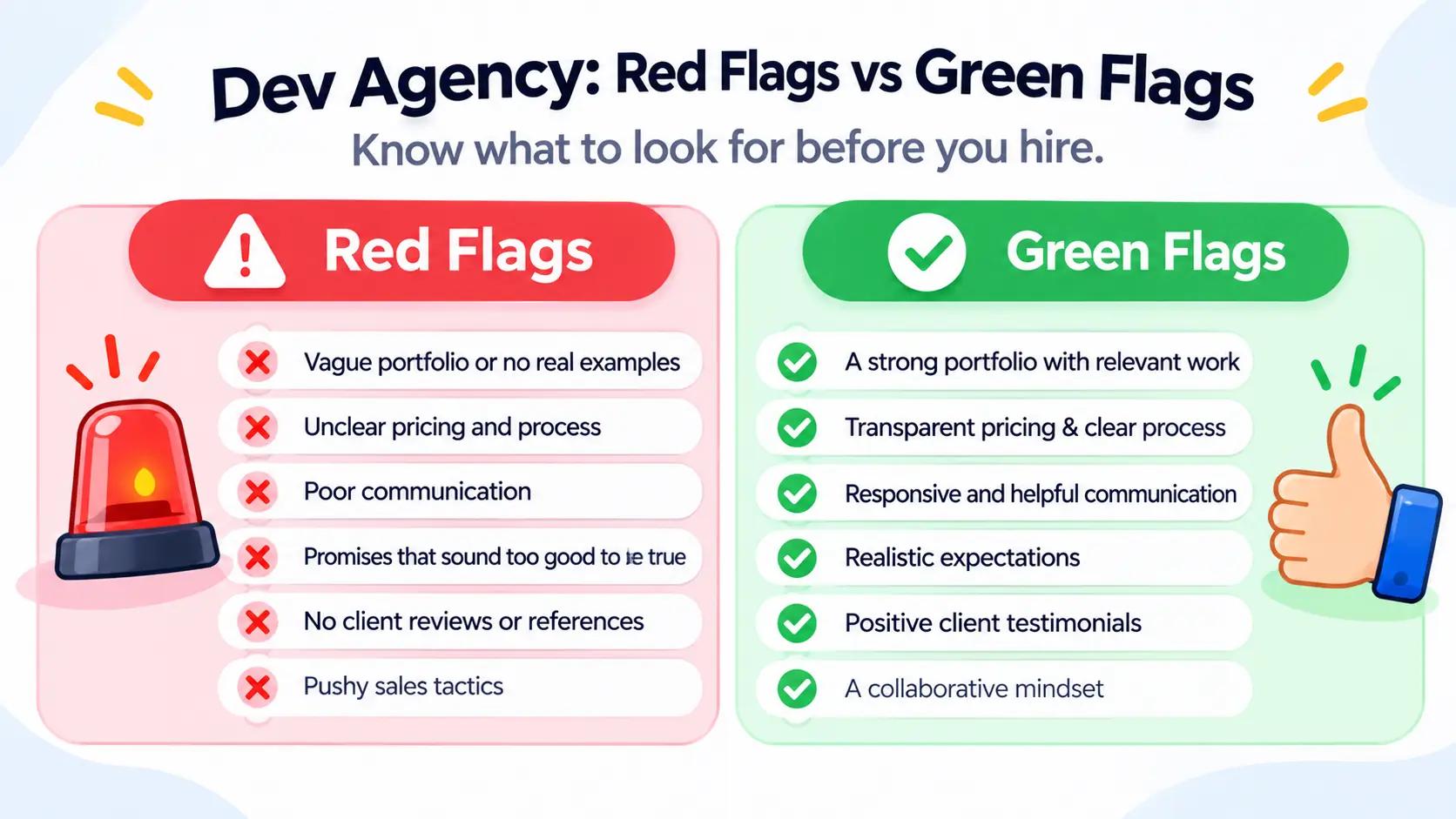
Walk away if:
Lean in if:
"Hire a developer" has three meanings, so a quick map. Freelancers cost less and suit well-scoped slices, but one person means one point of failure, and vacations are real. In-house engineers give you speed and ownership, but recruiting a senior developer takes months, and the full-time cost is brutal before product-market fit. An agency hands you a whole team (design, backend, frontend, QA) without recruiting a single one of them, at the price of nobody sitting in your Slack.
The pattern I'd bet on: agency or senior freelancer for v1, in-house hires once the product itself becomes the company.
| Factor | Vibe Coding | Dev Agency |
|---|---|---|
| Speed to first version | Days | 4–12 weeks |
| Upfront cost | $20–$200/month in tools | $20,000–$150,000+ per project |
| Code quality | Unpredictable — great until it isn't | Reviewed, tested, documented |
| Security | Your responsibility (often forgotten) | Usually built into their process |
| Scalability | Hits a wall fast | Designed for growth from day one |
| Maintenance | You own every line, like it or not | Ongoing support usually included |
| Who's accountable | You | Them (contractually) |
| Best for | MVPs, prototypes, internal tools | Production apps, complex systems |
| The dirty secret | The hidden cost | |
|---|---|---|
| Vibe coding | Looks finished long before it is — exposed keys, missing validation, weak auth | You're the only test suite, and "it works when I click it" isn't one |
| Agency | Economics reward longer timelines — discovery meetings, PMs, code you didn't need | Every tweak after sign-off is a change request with its own line item |
| Middle ground | Vibe code the prototype, get users, then pay pros to rebuild the proven version | $200 to learn what a $50,000 build needs — and the spec writes itself |
Vibe coding's dirty secret: AI-generated code looks finished long before it is finished. The happy path works. Every button does what the demo showed. What you can't see is the exposed API key sitting in the client-side code, the missing input validation on the signup form, and the authentication a security researcher (or a bored teenager) could walk straight through. These aren't rare edge cases. Researchers have found AI tools regularly produce code with exactly these flaws, not because the AI is bad, but because "it works when I click it" is the only test most vibe coders run. If your app touches real user data, that risk has your name on it.
The agency's dirty secret: You'll pay for weeks of discovery meetings, project managers, and code you didn't need. Agency economics reward longer timelines. The invoice grows with the schedule, and every tiny tweak after sign-off becomes a change request with its own line item. Pick the wrong agency and you're not buying software; you're renting a slow one.
The practical middle ground most founders miss: vibe code the prototype yourself, get users, then pay a developer (freelancer or agency) to rebuild the proven version properly. You spend $200 learning what a $50,000 build needs to be, and the spec writes itself. Your prompts, your user feedback, and your early analytics become the requirements document, which means the professionals build the right thing the first time instead of billing you to discover it.
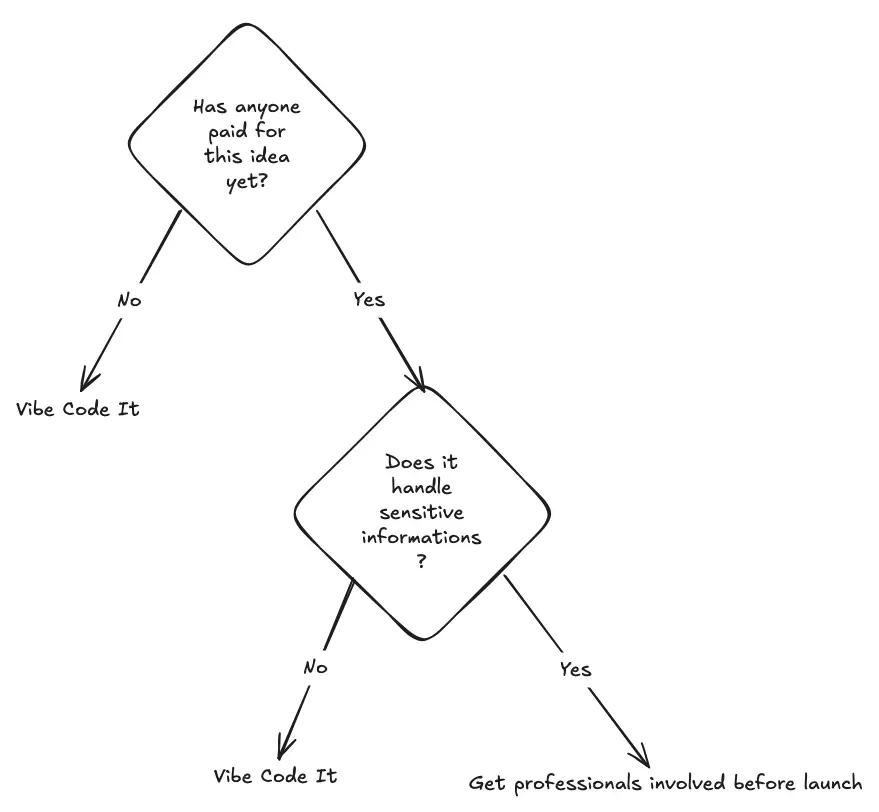
Ask yourself three questions:
Has anyone paid for this idea yet?
Does it handle money, personal data, or business-critical operations?
Will this codebase need to grow for 2+ years?
My honest recommendation for most early-stage founders: start with vibe coding. It's never been cheaper to find out whether your idea deserves a real budget. But treat what you build as a prototype, not a product, and budget for a professional rebuild once you've proven there's demand. The founders who get burned are the ones who vibe code a payment flow, launch it, and only learn about security when something goes wrong.
Speed is a feature. So is not getting breached. Pick the approach that matches which one you need right now.
Is vibe coding safe for production apps? For low-stakes products that touch no sensitive data, often yes. For anything handling payments, personal data, or regulated information, no. AI-generated code routinely ships with exposed API keys, weak authentication, and missing input validation, and those flaws only surface under attack. If a vibe-coded app has to go live, get a professional security review first.
Can I vibe code an MVP and hire an agency later? Yes, and it's often the smartest sequence. The prototype proves demand and produces real user feedback. Just plan for a rebuild rather than a patch: prototype code usually needs to be rewritten properly, not renovated.
How much does a dev agency cost? For a real product, expect $20,000–$150,000+ per project and 4–12 weeks to first release, depending on complexity. That buys reviewed, tested, documented code and someone contractually accountable when things break.
What should I ask an agency before signing? Five questions, in order. Who exactly writes the code, and can I see it every week? How are change requests priced when the scope moves? Who owns the IP, and from when? What does the handover include in writing? And what will you talk me out of building? That last one filters fastest. A good agency answers it with something specific.
What tools do vibe coders actually use? Cursor and Windsurf if you work in an editor. Lovable, Bolt, and v0 if you'd rather stay in the browser. Claude and similar AI assistants fit into both workflows.
Everything this article recommends has a specific shape: validate cheap, then build properly once demand is proven. That's the model Mate AI was built around.
Mate AI is an AI-powered development partner for startups and SMEs. The team builds the first version of your product, then scales what already works, which maps neatly onto the path described above:
The process is deliberately boring, in a good way. It starts with a free 30-minute call, moves to a written scope with a fixed price, runs as weekly iterative builds, and ends with either launch and ongoing support or a clean handover. You own the code and the IP. Check them against the red flags above; the fixed quotes, weekly staging demos, and handover terms are published on mateai.dev precisely so you can.
If you're at the "my prototype works and people are paying" stage, that's exactly the moment this article says to call in professionals. Book the free consultation or email james@mateai.dev.