How Long Does It Take to Build an MVP? Real 2026 Timelines
Published October 30, 2026
Have an idea worth shipping?
Book a free 30-minute call — no sales pitch, just a clear plan and a fixed-price quote for your product.
Book a free 30-minute call — no sales pitch, just a clear plan and a fixed-price quote for your product.
Ask five developers how long it takes to build an MVP and you'll get five different answers. One will tell you a weekend. Another will say six months. Both can be right, because they're probably talking about completely different things.
The honest answer is: most MVPs take anywhere from 3 days to 4 months, and which end of that range you land on depends almost entirely on three things: how you build it, how complex your product is, and how well you scope it.
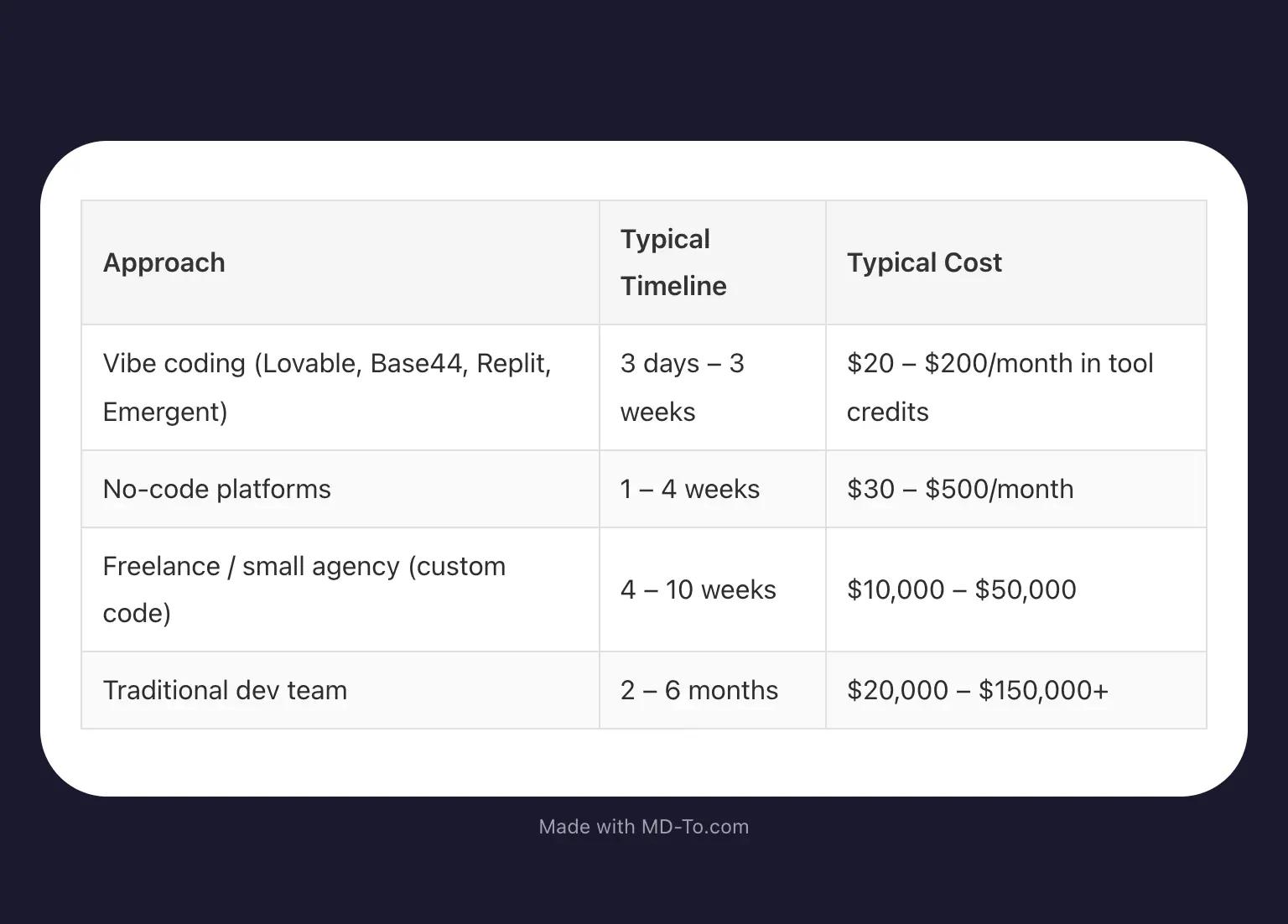
Here's where those numbers come from.
Vibe coding, describing what you want to an AI tool and letting it generate the app, has collapsed the MVP timeline. Tools like Lovable, Base44, Replit, and Emergent can take you from a blank page to a working web app in a single afternoon.
Realistic timelines by tool:
Here's the caveat nobody puts in the ads: vibe coding gets you a working prototype fast, not necessarily a production-ready product.
One founder on Reddit documented building an MVP in 25 days with vibe coding, then deciding to rebuild it. Vibe coding saved him "60 to 70 percent of the time" on writing code. The trade-offs showed up later: messy code structure, security gaps, and features that broke when he tried to scale them.
Vibe coding is right for you if:
It's wrong for you if:
Classic no-code tools (Bubble, Webflow, FlutterFlow, Glide) sit between vibe coding and custom development. You assemble with visual builders instead of prompting an AI.
A simple app takes 1–2 weeks. Something with multiple user roles, workflows, and integrations is realistically 3–4 weeks. The advantage over vibe coding: more predictable behavior and established patterns for common use cases. The disadvantage: you'll hit a ceiling faster, and experienced Bubble or Webflow developers can cost more than regular developers because the talent pool is smaller.
Most "traditional" MVP timelines you read about come from this path. The phases typically look like:
A focused custom MVP with an experienced team takes two to ten weeks and runs $10,000–$35,000. Larger agencies doing more complex builds push toward $50,000–$150,000 and 3–6 months.
What you're paying for: clean architecture, security done properly, and code your future team can maintain. If the MVP validates and grows, you build on it instead of starting over.
These blow up timelines regardless of approach:
1. Scope creep. The #1 killer. "Can we just add a chat feature?" turns a 3-week MVP into a 3-month project. The fix: write down your MVP's core job. If a feature doesn't serve that job, it goes on a "later" list.
2. Skipping the scoping phase. Founders who jump straight into building (especially with vibe coding) often rebuild two or three times because they never defined what "done" looks like. Spend one full day writing your spec before touching any tool. It saves you a week.
3. Integrations. Stripe is easy. Custom ERP connections, weird legacy APIs, and anything HIPAA-related quietly double your timeline.
4. Waiting on decisions. Honestly, in agency work the biggest delays usually aren't code. They're feedback loops. If a founder takes 4 days to approve a design, everything shifts. Decide in 24 hours and your project moves twice as fast.
5. Perfectionism. An MVP is a test, not a product. It needs to answer one question: "Will people use this?" It does not need dark mode, an onboarding video series, or 40 notification preferences.
If you've read this far, you probably want the custom-code path (clean architecture, security done properly, maintainable code) without the 6-month agency timeline or the $100k invoice. That's the gap Mate AI was built to fill.
Mate AI is an AI-powered development partner for startups and SMEs. Senior engineering plus AI-accelerated delivery gets an MVP live in weeks: their fintech case study went from Figma files to a live beta with paying users in six weeks.
What working with them looks like:
If your MVP handles real money or sensitive data, or you expect it to become the actual product, this is the "build properly second" option on a "validate fast" timeline. Start with the free consultation at mateai.dev.
Still unsure which route fits? Use this:
The tools have changed the math. What took 3 months in 2020 can genuinely be built in a weekend with vibe coding, for the right kind of product. But "fast to build" and "ready to scale" are still two different things. The most expensive mistake founders make isn't building too slowly. It's building the wrong thing quickly, or building the right thing in a way they'll have to throw away.
Pick the approach that matches your next milestone, not your dream version of the product. Validate first, build properly second.
What's the fastest way to build an MVP?
Vibe coding. With Lovable or Base44, a simple CRUD app can be working in a few hours and polished within a week. The catch: it's a prototype for validation, not a production-ready product.
Can you really build an MVP in a weekend?
For simple apps, yes: a directory, a basic booking tool, an internal dashboard. For anything with multiple user roles, integrations, or real transactions, no. A realistic weekend gets you a testable prototype, not a launch-ready product.
How much does an MVP cost?
Roughly $20–$200/month in tool credits if you vibe code it yourself, $30–$500/month on no-code platforms, $10,000–$50,000 with a freelancer or small agency, and $20,000–$150,000+ with a traditional dev team.
How long does a custom-coded MVP take?
Four to ten weeks with a focused team: 1–2 weeks of discovery and scoping, 1–2 weeks of design, 2–6 weeks of development, and about a week of testing and launch. Larger agencies with complex builds run 3–6 months.
Should I rebuild my vibe-coded MVP once it validates?
Often, but not always. If the codebase is small and reasonably clean, a developer can harden and extend it. If you're facing security gaps, messy structure, or features that break under load, a rebuild (or a rescue by an experienced team) is usually cheaper than patching.
When should I skip vibe coding entirely?
When you're handling sensitive data (payments, health records, anything compliance-heavy), your logic is genuinely complex, or the app needs to survive thousands of users on day one. Go custom from the start.
What's the single biggest reason MVPs get delayed?
Scope creep, and its cousin, skipping the scoping phase. Write down your MVP's core job, cut everything that doesn't serve it, and spend one full day on a spec before you build. That day typically saves a week.
How can I get custom-code quality without a months-long agency timeline?
Work with a lean, AI-accelerated development partner. Mate AI, for example, ships MVPs in weeks with fixed-price quotes, weekly demos on a live staging link, and senior engineers reviewing everything. Book a free consultation at mateai.dev.