How to Build an MVP Fast in 2026
Published October 29, 2026
Have an idea worth shipping?
Book a free 30-minute call — no sales pitch, just a clear plan and a fixed-price quote for your product.
Book a free 30-minute call — no sales pitch, just a clear plan and a fixed-price quote for your product.
Six months used to be the standard timeline for getting a minimum viable product out the door. A small team, a bunch of sprints, a decent invoice from a dev shop, and hopefully something you could put in front of users.
That timeline is dead. Lovable hit $100M in annual recurring revenue faster than almost any software company in history, built entirely on the premise that anyone should be able to ship an app in a weekend. Base44 was bootstrapped by a solo founder using AI-assisted development, grew to millions of users, and got acquired by Wix within about six months of launching. The tools that make "build it in a week" possible are the same ones eating the traditional dev process.
But here's the part most articles skip: fast MVPs fail all the time too. The speed of the tool doesn't save you from building the wrong thing, shipping something insecure, or painting yourself into a corner with a prototype you can't scale.
This guide covers which approach fits your situation and the mistakes that turn a weekend project into a three-month rewrite.
An MVP is not a rough version of your final product. It's the smallest thing that lets you test your riskiest assumption with real users.
The classic examples still hold up because the principle hasn't changed:
Notice what they have in common: none of these founders tested whether the technology worked. They tested whether anyone wanted the thing. That's the mindset to bring before you open Lovable or spin up Cursor.
The practical test: if your MVP idea needs more than a sentence or two to explain the core loop, it's too big. Cut it again.
Tools like Lovable, Base44, Bolt, Replit Agent, and Emergent let you describe an app in plain English and get a working, deployable product. You type what you want, the AI generates the frontend, hooks up a database, handles auth, and pushes it live.
Best for: founders and non-technical builders who need a real, functional app (not just a landing page) without hiring developers.
Quick reality check on the big names:
The honest limitation: these tools handle CRUD apps, internal tools, dashboards, marketplaces, and booking systems well. They struggle with genuinely novel logic, heavy integrations, and anything requiring fine-grained security. Costs also scale fast: with token-based pricing, an app that cost $20/month in month one can cost hundreds by month three if usage grows and your prompts are inefficient.
This is what most working developers do now: write the code yourself, with an AI pair programmer doing the boilerplate. A competent developer using Cursor can build in a week what used to take a month.
Best for: teams with at least one developer, products with real security or compliance requirements, and anything you plan to scale seriously.
Why it matters even if you start with a no-code tool: every serious no-code MVP eventually hits a ceiling. The good news (and this is a pattern we see constantly) is that exporting from Lovable or Base44 to GitHub and continuing in a real environment is now a documented, repeatable process. It takes a few hours, not a rewrite.
Don't overlook the original MVP trick. A landing page with a waitlist, a Typeform, a Notion database, a Stripe payment link, and manual fulfillment behind the scenes can validate your idea in a day for almost nothing. If your assumption is "people want this," you don't need software to test it. You need a way to capture interest and measure it.
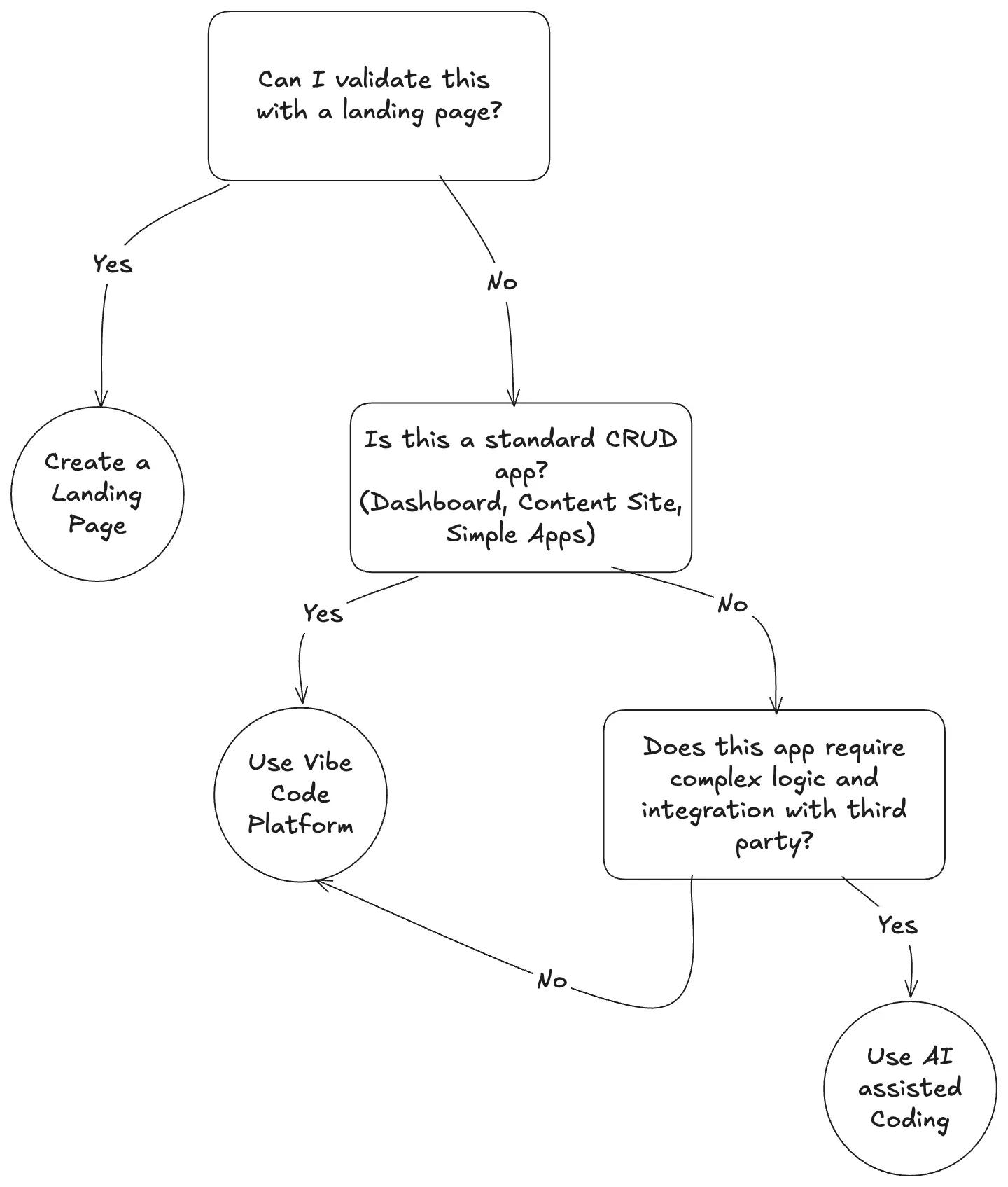
Ask yourself three questions:
Nothing stops you from combining all three: landing page in week one, real MVP on Lovable in week two, proper codebase in month three once revenue justifies it. That's a completely legitimate 2025 product strategy.
Speed is only an advantage if you don't waste it. These are the failure modes we see over and over:
1. Building for six weeks before talking to a user. The tools made building cheap, but founders still treat building as the goal. Set a hard rule: something in front of a real human within 7–14 days, even if it's ugly.
2. Skipping security entirely. Vibe-coded apps are notorious for weak authentication, exposed API keys, and missing data protection, because the AI only implements what you ask for, and nobody asks for "row-level security policies." If your MVP touches real user data, have someone with security knowledge review it before launch. This is non-negotiable.
3. Prompting without a plan. The difference between a great and terrible no-code result usually isn't the tool. It's whether the person wrote down their app's core features, data model, and user flow before prompting. Twenty minutes of planning saves days of AI regenerating the same broken screen.
4. Vibe-checking the code instead of testing the product. AI-generated code that looks right often isn't. Test the actual user flows yourself, on mobile, with real data, before you show anyone.
5. Treating the prototype as the foundation. Fast MVP code is scaffolding, not a house. If the product gets traction, budget for a proper engineering phase early. Retrofitting scale onto a vibe-coded base costs more than building it properly the first time.
Here's a realistic version of "MVP fast" in 2025:
That's a validated product in a month. Two years ago, that timeline was fantasy.
The tool you pick matters less than the discipline you bring to it. The founders winning with vibe coding aren't the ones using the trendiest platform. They're the ones who cut scope ruthlessly, talked to users early, and knew exactly when to graduate from prototype to real engineering.
A landing page with a waitlist and manual fulfillment behind the scenes. You can have it live in a day for almost nothing, and it tests the assumption that matters most: whether anyone wants the thing. It's the fastest MVP that exists.
About a month if you're disciplined. Landing page in week one, the core loop on a vibe coding platform in weeks two and three, iteration from real feedback after that. Compare that to the six months a dev shop used to quote.
Yes. Tools like Lovable, Base44, Bolt, Replit Agent, and Emergent turn plain-English descriptions into working, deployable apps. They're strongest on standard patterns: CRUD apps, dashboards, marketplaces, and booking systems. Lovable wins on design; Base44 wins on speed-to-live.
Often not. They're notorious for weak authentication, exposed API keys, and missing data protection, because the AI only builds what you ask for and nobody asks for "row-level security policies." If your MVP touches real user data, get a security review before launch.
Yes. Exporting from Lovable or Base44 to GitHub and continuing in a real development environment is a documented, repeatable process that takes a few hours, not a rewrite. Plan the transition once the product has traction.
The entry price is low, but token-based pricing is what bites. An app that costs $20/month in month one can cost hundreds by month three if usage grows and your prompts are inefficient. A landing page plus Typeform and Stripe costs almost nothing.
When the product involves payments, sensitive user data, or complex custom logic, or when you plan to scale seriously. With AI-assisted coding in Cursor, Claude Code, or Copilot, a competent developer can build in a week what used to take a month.
Everything in this guide is doable solo. But if you'd rather spend your energy on customers and product decisions than on prompting, debugging, and security reviews, that's what we do at Mate AI.
We're a development partner for startups and SMEs:
Every engagement starts with a free 30-minute consultation, you get a written scope with no surprises later, and you own the code and IP. If the honest answer is "you don't need us for this," we'll tell you that too. Book a call and find out.